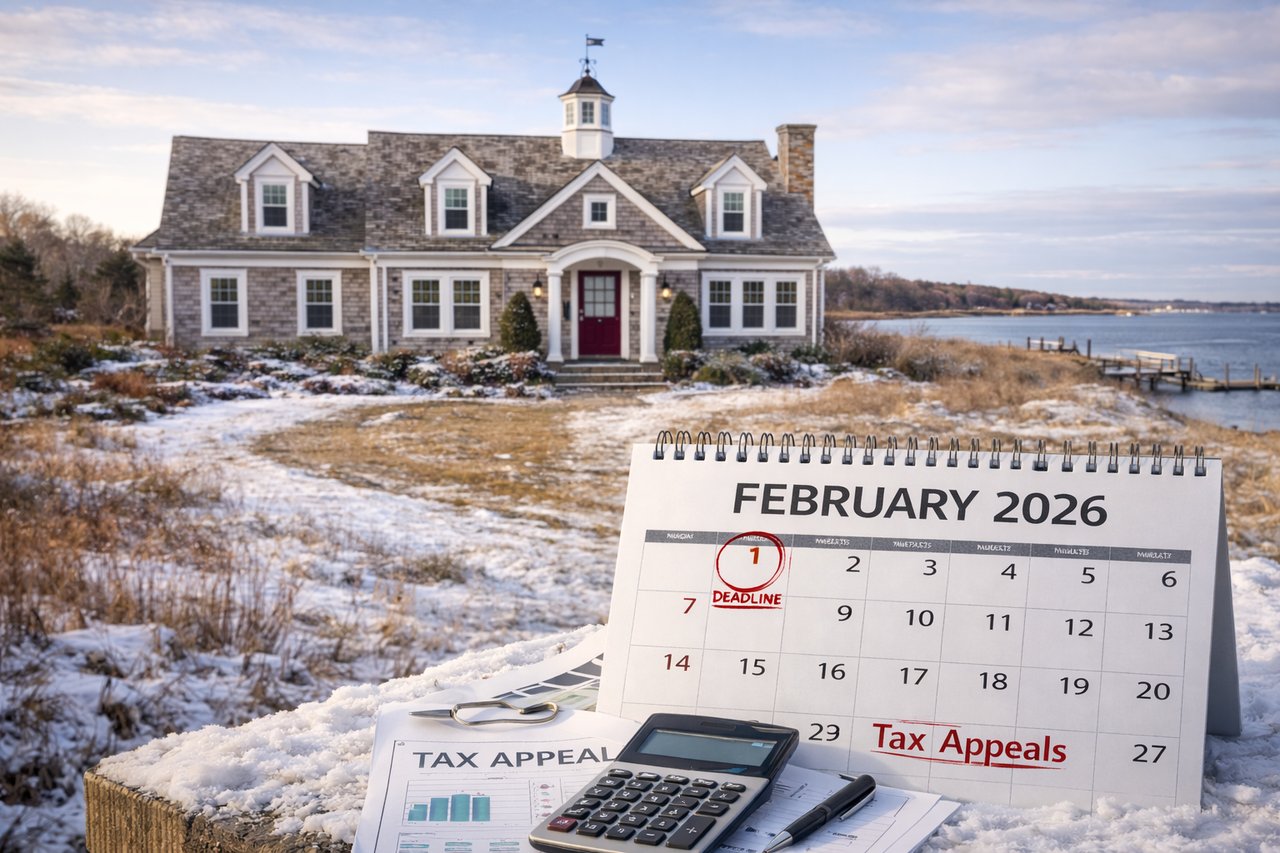
Cape Cod Property Tax Appeals 2026: Exact Strategy to Beat the February Deadline
FY2026 property tax bills just hit Cape Cod mailboxes, and many homeowners are stunned at assessment increases—Brewster saw median single-family values jump 4.5%, Chatham's values rose 4.6%, and waterfront villages across the Cape experienced increases in the 8-15% range based on strong 2024 sales. If your assessment looks wrong, you have until early February 2026 to challenge it—and missing this deadline by even one day means automatic denial, no matter how strong your case.
Critical Deadlines:
Who This Applies To:
What You Need:
Common Reasons for Appeal:
The assessment on your FY2026 bill was set on January 1, 2025, based on sales from 2024. As of January 8, 2026, analyzing recent Cape Cod market data, if your property has condition issues the town's model didn't capture, if comparable properties sold for less than your assessment, or if your neighborhood saw limited sales that don't support your valuation, you have grounds for an abatement. But the window to act is measured in weeks, not months—and the filing requirements are strict.
Deborah Camuso has helped Cape Cod homeowners navigate property valuations for over 25 years, using the same MLS data and local market expertise that makes her one of Cape Cod's top real estate brokers. With direct access to village-level sales data across towns like Yarmouth, Harwich, and Brewster, she understands exactly how assessors arrive at valuations and where they often miss property-specific realities. Here's the exact strategy to challenge your FY2026 assessment before the deadline, what evidence you need, and how to position your appeal for success.
A property tax abatement in Massachusetts is a reduction in your FY2026 tax bill because the town agrees your assessment was incorrect. You're not arguing that Cape Cod's tax rates are too high—you're arguing that your specific property's assessed value is wrong compared to what it could actually sell for as of January 1, 2025.
Cape Cod homeowners file abatements for four main reasons:
Overvaluation: Your assessed value exceeds what your property would have reasonably sold for on January 1, 2025. This is the most common reason, especially in towns where assessors used aggressive appreciation models based on limited high-priced sales that don't represent your specific property or neighborhood.
Disproportionate assessment: Your assessment increased far more than comparable properties in your village or neighborhood. If your assessment jumped 12% while similar homes on your street increased 4-6%, you have a disproportionality argument even if your absolute value isn't technically "wrong."
Property-specific issues not captured: Your home has condition problems, deferred maintenance, septic limitations, flood zone requirements, easements, or functional obsolescence that the town's mass appraisal model couldn't see from the street or capture in standardized data.
Misclassification: The property is incorrectly classified (residential vs. commercial, wrong land use code, missing exemptions you qualify for). This is less common but easy to fix when identified.
The goal isn't to eliminate your tax bill—it's to get your assessment aligned with fair market value so you're not paying taxes on phantom equity that doesn't exist.
Massachusetts law is unforgiving on abatement deadlines. As of January 8, 2026, if you received your FY2026 actual tax bill in late December 2025 or early January 2026, you have only weeks remaining to file. If you miss the deadline, your appeal cannot be heard—period. No exceptions, no extensions, no "I didn't know" arguments.
The deadline rule: Abatement applications must be filed by the due date of the first actual (not preliminary) tax bill installment for FY2026.
For Cape Cod's quarterly-billing towns (which includes all 15 Cape communities), that first actual installment is the 3rd-quarter bill, typically due February 1, 2026. If February 1 falls on a weekend or holiday, it automatically moves to the next business day.
Your specific deadline is printed on your tax bill next to the 3rd-quarter payment due date. Circle it. Put it in your phone. Miss it by one day and your abatement is dead—the Board of Assessors has no authority to accept late filings under Massachusetts General Laws Chapter 59.
Critical filing requirements:
The 15 Cape Cod towns all follow this same deadline structure: Barnstable, Bourne, Brewster, Chatham, Dennis, Eastham, Falmouth, Harwich, Mashpee, Orleans, Provincetown, Sandwich, Truro, Wellfleet, and Yarmouth all use quarterly billing with the February 1 deadline. Check your bill for your town's exact date.
This isn't "file by February and we'll probably get to it"—this is "postmarked by February 1 or your case is over before it starts."
Understanding how your town arrived at your assessment helps you build a stronger appeal.
Assessment date: January 1, 2025. Every FY2026 assessment represents what the town believes your property was worth on that specific date, regardless of what's happening in the market today.
Data used: Sales from 2024 (primarily), plus property characteristics from town records. Assessors run mass appraisal models that analyze comparable sales, apply appreciation factors by neighborhood or property type, and generate valuations for every property in town.
Why these models fail for individual properties: Mass appraisal works reasonably well at the aggregate level but often misses property-specific realities. The model doesn't know your septic is failing, your foundation has cracks, your lot has wetland constraints, or that the three sales the town used as "comparables" were all fully renovated waterfront homes while yours is an inland fixer.
While comprehensive town-by-town data isn't yet published in aggregated form as of January 8, 2026, available reports from individual Cape communities reveal consistent appreciation patterns that drove FY2026 assessments:
|
Town |
Available FY2026 Data |
Context |
|
Brewster |
4.5% median SF increase |
Moderate appreciation, inland location |
|
Chatham |
4.6% overall value increase |
Premium market, waterfront drove increases |
|
Harwich |
Full revaluation completed |
Village-level variation significant |
|
Yarmouth |
Assessment increases reported |
Village spread from +6.5% to -2.5% in 2025 sales |
|
Barnstable |
Ongoing revaluation |
Osterville/waterfront higher increases |
|
Other Cape Towns |
Data pending aggregation |
Check your town assessor website |
Source: Individual town reports and Deborah Camuso market analysis, January 2026
What this table shows: Even where data is available, town-wide numbers mask significant variation. Harwich saw full revaluations with dramatic village differences. Yarmouth's villages ranged from strong appreciation to declines. Your specific property's assessment depends on your neighborhood's 2024 sales—not the town average.
Cape Cod's 2024-2025 market context: Strong sales activity in waterfront and premium villages drove appreciation, but the market wasn't uniform. Waterfront and premium neighborhoods across the Cape typically experienced 8-15% assessment increases, while more affordable inland areas saw 3-7% jumps based on their specific 2024 sales patterns.
Your abatement needs to prove your property is the exception to whatever model the town used.
Before you consider appealing, understand what your bill is telling you.
Find these key numbers:
Quick assessment sanity check:
Common red flags that suggest abatement potential:
Step 1: Free Cape Cod Assessment Checkup
Email me a photo of your FY2026 tax bill and your property address. I'll pull actual 2024-2025 comparable sales in your specific Cape town and village, compare them to your assessed value, and tell you in plain language:
Simple, fast, no obligation. I've been analyzing Cape Cod property values for 25+ years and have access to MLS data most homeowners never see.
Call: 508-335-3875 or email [email protected] with "FY2026 Assessment Review" in the subject line.
Step 2: Decide If an Abatement Is Worth Your Time
Not every assessment increase justifies an appeal. Focus on cases where the potential tax savings outweigh the effort.
Abatements typically make sense when:
The dollar difference is meaningful. If your assessment is $150K over fair market value on a property assessed at $900K, that's a $1,000+ annual tax savings at typical Cape rates. Over 5-10 years, that's $5,000-$10,000 in your pocket. If the difference is $15K on a $400K assessment, the savings may not justify the effort unless you have a slam-dunk case.
You have clear evidence of overvaluation. Three comparable sales in your village from 2024 all closed at $750K-$800K, but you're assessed at $950K with similar size, condition, and location. That's a strong case. If you're assessed at $820K and comps range from $750K-$850K, that's weaker.
Your property has specific issues the town missed. Septic failing, foundation cracks, roof needs replacement, wetland restrictions on lot, shared driveway limiting value, flood insurance requirements—these all reduce fair market value but may not be captured in the assessment. Document them and you have a case.
Your assessment increased disproportionately. You're up 14% while neighbors increased 5-6% with similar homes. Even if your absolute value isn't technically "wrong," Massachusetts law allows abatements for disproportionate assessments relative to comparable properties.
You're in a higher-value property bracket. The higher your assessment, the more even a small percentage reduction saves. A 5% reduction on a $1.5M assessment saves $5,000+ annually at Cape rates. On a $400K assessment, 5% saves maybe $1,300/year—still meaningful, but lower ROI on your time.
Situations where abatement may not be worth it:
The borderline cases are where expert analysis pays off—I can tell you whether the evidence supports an appeal or whether you're better off accepting the assessment and moving on.
Step 3: Gather Cape-Specific Evidence That Wins Appeals
Massachusetts law requires you to prove your case with evidence. "My taxes are too high" doesn't work. "Here are three comparable sales showing my property is overvalued by $120K" does work.
Evidence Type 1: Recent Comparable Sales (Most Powerful)
The gold standard for abatement evidence is actual arm's-length sales of truly comparable properties around January 1, 2025 (the assessment date).
What makes a good comp for Cape Cod:
Example of strong comp evidence: "My property is assessed at $925,000. Three comparable homes in West Dennis sold in 2024: 123 Beach Road ($795K, similar size/condition), 456 Shore Drive ($815K, similar but better condition), 789 Ocean Way ($780K, similar but waterfront). These sales support a value of approximately $800K-$825K, not $925K."
Where I can help: I have access to complete MLS data for every Cape Cod town, including sales that never hit public websites, detailed property characteristics, and actual sold prices (not just list prices). I can pull the 5-10 best comps for your property in minutes—comps that would take you hours to find and verify.
Evidence Type 2: Property-Specific Condition Issues
Document anything that reduces your property's value that the assessor wouldn't know from the street or public records.
Examples that strengthen appeals:
How to document: Photos with dates, written contractor estimates or inspection reports, town conservation commission correspondence, flood maps, any professional reports you have.
Evidence Type 3: Income/Expense Data (For Rentals)
If you own a two-family, multi-unit, or short-term rental property, net operating income (NOI) can support a lower value under the income approach to valuation.
What you need:
This is more technical, but if you're running a rental property where the numbers don't support the assessed value, it's powerful evidence.
Evidence Type 4: Assessment History (Supporting Disproportionality)
Pull your assessment history and your neighbors' history to show disproportionate increases.
Example: "My FY2025 assessment was $750K. My FY2026 assessment is $862K (14.9% increase). Comparable properties at 10 Main Street and 15 Main Street increased 5.2% and 6.1% respectively. My home has not changed physically—this increase is disproportionate to similar properties."
Want Professional Evidence Without Doing the Research?
Free Abatement Evidence Package for Cape Homeowners Considering Selling
If you're thinking about selling in the next 12-24 months, I'll prepare a complete evidence packet for your abatement at no cost:
✓ Best 2024-2025 comparable sales in your town and village, with detailed analysis
✓ Property condition assessment based on walkthrough and market positioning
✓ Valuation estimate you can attach to your abatement application
✓ Strategic guidance on whether to file and how to present your case
Why I do this: The same valuation work that supports your abatement also informs your eventual pricing strategy when you're ready to sell. You get free abatement help now, and we have a conversation about your property's true market value that benefits you whether you appeal or not.
Email: [email protected] or call 508-335-3875 to schedule a property walkthrough.
Step 4: File Correctly and On Time in Your Cape Town
Every Cape Cod town follows Massachusetts General Laws Chapter 59, but each has its own assessor's office, forms, and addresses.
1. Use the official form. Download it from your town's assessor website or pick one up in person. Search "[Your Town] MA assessors abatement application" to find it. The form will reference MGL Chapter 59.
2. File by the deadline. Your application must be received by the Board of Assessors or postmarked by USPS no later than the date printed on your 3rd-quarter FY2026 bill (typically February 1, 2026). Late applications cannot be accepted by law—assessors have no discretion.
3. File with the right office. Applications go to the Board of Assessors, not the tax collector. The address is on your tax bill. If mailing, use certified mail with return receipt so you can prove timely filing.
4. Complete the application fully. The form asks for your property information, the assessment you're appealing, and your estimate of fair cash value. Be conservative but realistic—if comps support $800K and you're assessed at $950K, request $800K, not $700K hoping to split the difference.
5. Attach your evidence. Include a cover letter summarizing your argument, plus attachments: comparable sales sheets, photos, contractor estimates, whatever supports your case. Make it easy for the assessors to understand why you're right.
What your cover letter should say:
"Dear Barnstable Board of Assessors,
I am appealing my FY2026 assessment of $925,000 for the property at [address]. Based on recent comparable sales and property-specific factors, I believe the fair cash value as of January 1, 2025 was $810,000.
Supporting evidence: - Three comparable sales in West Dennis from 2024 (attached MLS sheets) ranging from $780K-$825K - Property condition issues including roof needing replacement (contractor estimate attached) - Lot constraints due to wetlands limiting buildable area (conservation plan attached)
I respectfully request an abatement reducing my assessment to $810,000. I am available to meet with the assessors or provide additional information. Thank you for your consideration.
Sincerely, [Your Name]"
Be professional, factual, and concise. Assessors review hundreds of applications—make yours easy to understand and well-supported.
Step 5: What Happens After You File
Once your Cape town has your timely, complete application, the process moves forward on a statutory timeline.
Assessors' timeline: Massachusetts law gives the Board of Assessors up to three months after filing to act on your application. They may:
Possible outcomes:
Full abatement: The town agrees with your valuation and reduces your assessment. You'll receive a notice and either a refund check (if you already paid) or an adjusted bill for remaining quarters.
Partial abatement: The town agrees you're overassessed but not by as much as you claimed. They reduce your assessment to a middle-ground number. You can accept this or appeal further.
Denial: The town believes the assessment is correct and denies your application. You'll receive a written denial notice.
Deemed denial: If the assessors don't act within three months, your application is automatically "deemed denied" under the statute, which preserves your right to appeal.
If denied or only partially granted:
You have the right to appeal to the Massachusetts Appellate Tax Board (ATB), generally within three months of the denial notice or deemed denial. The ATB is a more formal proceeding—you present evidence, the town presents evidence, and the ATB issues a decision. Many homeowners hire attorneys or appraisers for ATB appeals, especially on higher-value properties where the potential savings justify professional representation.
Important: You must pay your taxes in full to maintain appeal rights. If you don't pay while appealing, you lose the right to challenge the assessment.
For most Cape Cod homeowners, the local assessor stage is the main event. If your case is strong and well-documented, many towns will grant full or partial abatements without requiring ATB appeals.
Several factors make FY2026 a good year for Cape abatement appeals:
Uneven 2024 market: While some waterfront villages saw strong appreciation (8-15% increases), inland areas and more affordable neighborhoods had much more modest gains (3-7%). If your town applied broad appreciation factors without accounting for micro-market differences, you may be overassessed.
Limited sales in some villages: Many Cape villages had very thin sales volume in 2024, meaning assessors based valuations on 5-10 transactions that may not represent the broader market. If your property is different from those few sales, you're likely overassessed.
Condition issues common in Cape housing stock: Many Cape homes are 40-80+ years old with original systems, seasonal use history, and deferred maintenance. Mass appraisal models assume average condition—if yours is below average, you have a case.
Waterfront vs. inland valuation challenges: Assessors sometimes over-apply waterfront appreciation to nearby non-waterfront properties, or fail to account for flood zone impacts on waterfront parcels. If you're waterfront with high flood insurance costs, or inland incorrectly valued like waterfront, you have evidence for appeal.
Recent sales data I'm seeing: Across the Cape towns I track closely—Yarmouth, Dennis, Harwich, Brewster—I'm seeing consistent patterns where FY2026 assessments are running 5-10% above what properties would actually sell for today based on current market conditions. That gap creates abatement opportunity.
Q: What's the difference between appealing my assessment and just paying less in taxes? A: An abatement reduces your assessed value, which then reduces your tax bill. You're not asking the town to charge you a lower rate—you're proving your property is worth less than the assessment, so the tax calculation starts from a lower base. If successful, you get a refund for overpaid taxes and a lower bill going forward.
Q: Can I appeal even if my assessment only increased a small amount? A: Yes, but focus your effort where the potential savings justify the work. If your assessment is $10K-$20K over fair value on a $400K property, the annual tax savings may be $200-$300—meaningful but modest. If you're $100K-$150K over on a $1M property, you could save $1,000-$1,500 annually. The higher the assessment and the larger the dollar difference, the more an appeal makes sense.
Q: What if I don't have comparable sales data—can I still appeal? A: Yes, though comps are the strongest evidence. You can appeal based on property condition (with contractor estimates, photos, inspection reports), income data if it's a rental property, or disproportionality (showing your increase was much higher than neighbors without justification). However, comps are what assessors find most persuasive. This is where having MLS access makes a huge difference—I can pull the exact comps assessors need to see.
Q: How long does the abatement process take? A: Assessors have up to 3 months from your filing to act on your application. Many Cape towns respond within 4-8 weeks, especially for well-documented cases. If you disagree with their decision, you then have 3 months to appeal to the Massachusetts Appellate Tax Board, which is a more formal proceeding that can take 6-12 months.
Q: Will appealing my assessment trigger an audit or inspection of my property? A: Assessors may request to inspect your property as part of reviewing your abatement, but they cannot force entry without your permission. If they request an inspection, it's often because they want to verify condition issues you've claimed—which can actually help your case. However, they also might discover improvements you made that aren't yet in their records, so be aware of that possibility.
Q: I already paid my first two quarters—can I still appeal? A: Absolutely. The abatement deadline is tied to the due date of the third quarter bill (the first "actual" bill), regardless of whether you've paid earlier preliminary bills. If your abatement is granted, you'll receive a refund for any overpayment from all quarters.
Q: What happens if I miss the February 1 deadline? A: Your abatement cannot be heard, period. Massachusetts law gives assessors no discretion to accept late filings—one day late means automatic denial. The only exceptions are if the deadline falls on a weekend/holiday (it moves to next business day) or in very rare procedural circumstances. This is why treating it as an absolute deadline is critical.
Q: Should I hire an attorney or appraiser for my abatement? A: For most residential properties under $1M with straightforward overvaluation cases, you don't need professional representation at the local assessor level. A well-documented application with good comps, property condition evidence, and a clear cover letter is usually sufficient. However, if you're dealing with a high-value property ($1.5M+), complex valuation issues, or an appeal to the Appellate Tax Board, professional help may be worth the cost.
As of January 8, 2026, the deadline to act is measured in weeks, and once it passes, your options disappear.
If you own a home anywhere on Cape Cod—Barnstable, Bourne, Brewster, Chatham, Dennis, Eastham, Falmouth, Harwich, Mashpee, Orleans, Provincetown, Sandwich, Truro, Wellfleet, or Yarmouth—and your FY2026 tax bill just arrived with a shocking assessment increase, there's a narrow window to challenge it before the February 1 deadline.
✓ Cape-Specific Assessment Checkup: I'll compare your FY2026 assessed value to actual 2024-2025 sales in your specific town and village, using MLS data most homeowners never see.
✓ Plain English Recommendation: "Appeal now," "Appeal only if...," or "No appeal needed"—clear guidance based on actual evidence, not guesswork.
✓ If Appeal Makes Sense: Step-by-step plan and help assembling the comparable sales and documents that make your case stronger. I'll pull the comps, explain the strategy, and show you exactly how to file.
✓ Bonus for Sellers: If you're thinking about selling in the next 12-24 months, this same valuation work becomes your pricing strategy conversation. You get free abatement help now and an expert opinion on your property's true market position.
Three ways to get started:
Option 1: Email your FY2026 tax bill (photo or PDF) and property address to [email protected] with "Assessment Review" in the subject line. I'll respond within 24 hours with initial assessment.
Option 2: Call 508-335-3875 to schedule a 15-minute phone consultation or in-person property walkthrough.
The deadline is real. The savings are real. The strategy is here.
I've been helping Cape Cod homeowners navigate property valuations for over 25 years as one of the Cape's top-producing real estate brokers. I know every town, every village, and what properties actually sell for versus what assessors think they're worth. Whether you appeal or not, you'll understand your property's true value and your options before the deadline passes.
Don't let one missed deadline cost you thousands. Let's review your assessment today.
Deborah Camuso
Cape Cod Real Estate Broker | 25+ Years Local Expertise
508-335-3875 | [email protected] | debcamuso.com
ABOUT THE EXPERT
Deborah Camuso is a Cape Cod real estate broker with 25+ years of experience and direct access to Barnstable County MLS data across all 15 Cape towns. She specializes in property valuation analysis and has helped hundreds of Cape Cod homeowners understand their property's true market value—whether for tax appeals, pricing strategy, or investment decisions. With village-level market knowledge spanning Barnstable to Provincetown, her valuation reports are used by buyers, sellers, investors, and homeowners challenging assessments.
Contact: [email protected] | 508-335-3875 | debcamuso.com
Legal framework and procedural guidance based on Massachusetts General Laws Chapter 59 and standard practices across Barnstable County's 15 towns. Assessment increase data reflects available town reports for Brewster (4.5% median SF increase) and Chatham (4.6% value increase) as examples of FY2026 patterns. Comprehensive town-by-town percentage changes not yet published in aggregated form. Tax savings calculations are estimates based on typical Cape Cod tax rates ($3.47-$10.57 per $1,000 of assessed value). This content is for informational purposes and does not constitute legal or tax advice. Consult with qualified professionals for specific situations. Abatement filing deadlines and procedures subject to individual town variations—always verify deadline printed on your specific tax bill.




Deborah would love an opportunity to talk with you and show you why it would be a benefit to work with her. In a world full of uncertainty, she will guide you in the correct direction and ensure that you make the most confident decisions. Connect with Deborah - She is here to offer insight and support whenever you are ready.
Work With Deborah