How to Evaluate Falmouth’s Micro-Locations If You Want the Best Appreciation Over Time
In Falmouth, long-term appreciation is driven less by timing and more by how specific micro-locations align with enduring buyer demand.
This analysis reflects how Deborah Camuso evaluates Falmouth micro-locations for buyers and sellers, based on long-term appreciation patterns, buyer behavior, and village-level demand trends observed across the Falmouth market.
Falmouth is often described as one market, but in practice it functions as dozens of overlapping micro-markets, each with its own buyer profile, demand durability, and pricing behavior.
Two homes can be less than a mile apart and experience dramatically different appreciation trajectories over time — not because of square footage or finishes, but because of how buyers emotionally and practically use the location.
That’s why evaluating Falmouth for long-term appreciation requires going beyond generic metrics and focusing on micro-location alignment with buyer demand.
This is where most buyers — and many sellers — get it wrong.
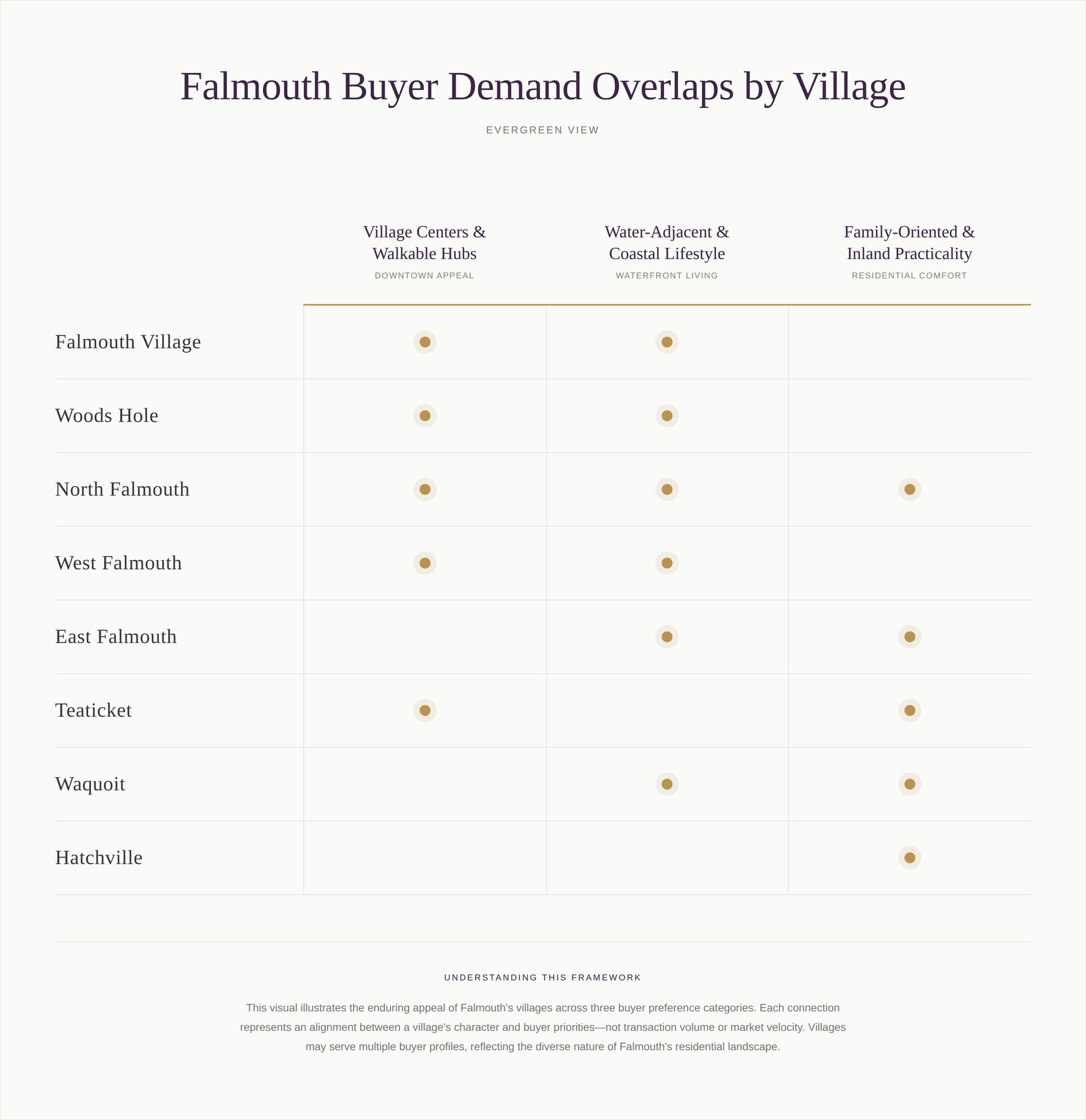
This first visual illustrates a critical truth:
The strongest appreciation occurs where multiple buyer motivations overlap.
In Falmouth, buyer demand tends to cluster around four primary drivers:
Walkability & village life
Water access or water influence
Year-round livability
Lifestyle convenience (schools, culture, recreation, commuting ease)
What makes Falmouth unique is that certain villages and sub-neighborhoods satisfy multiple drivers at once, while others satisfy only one.
Areas like Falmouth Village, Woods Hole, Quissett, and portions of West Falmouth consistently show overlapping demand from:
Second-home buyers
Downsizers
Year-round residents
Lifestyle-driven buyers (walkability, boating, culture)
These overlaps create price resilience, faster absorption, and stronger recovery after market shifts .
By contrast, locations that appeal to only one buyer profile — such as seasonal-only or price-driven segments — tend to show more volatility and flatter long-term appreciation.
Many buyers focus heavily on when they buy.
But in Falmouth, where you buy matters far more than when.
That’s because long-term appreciation here follows enduring buyer priorities, not short-term cycles.
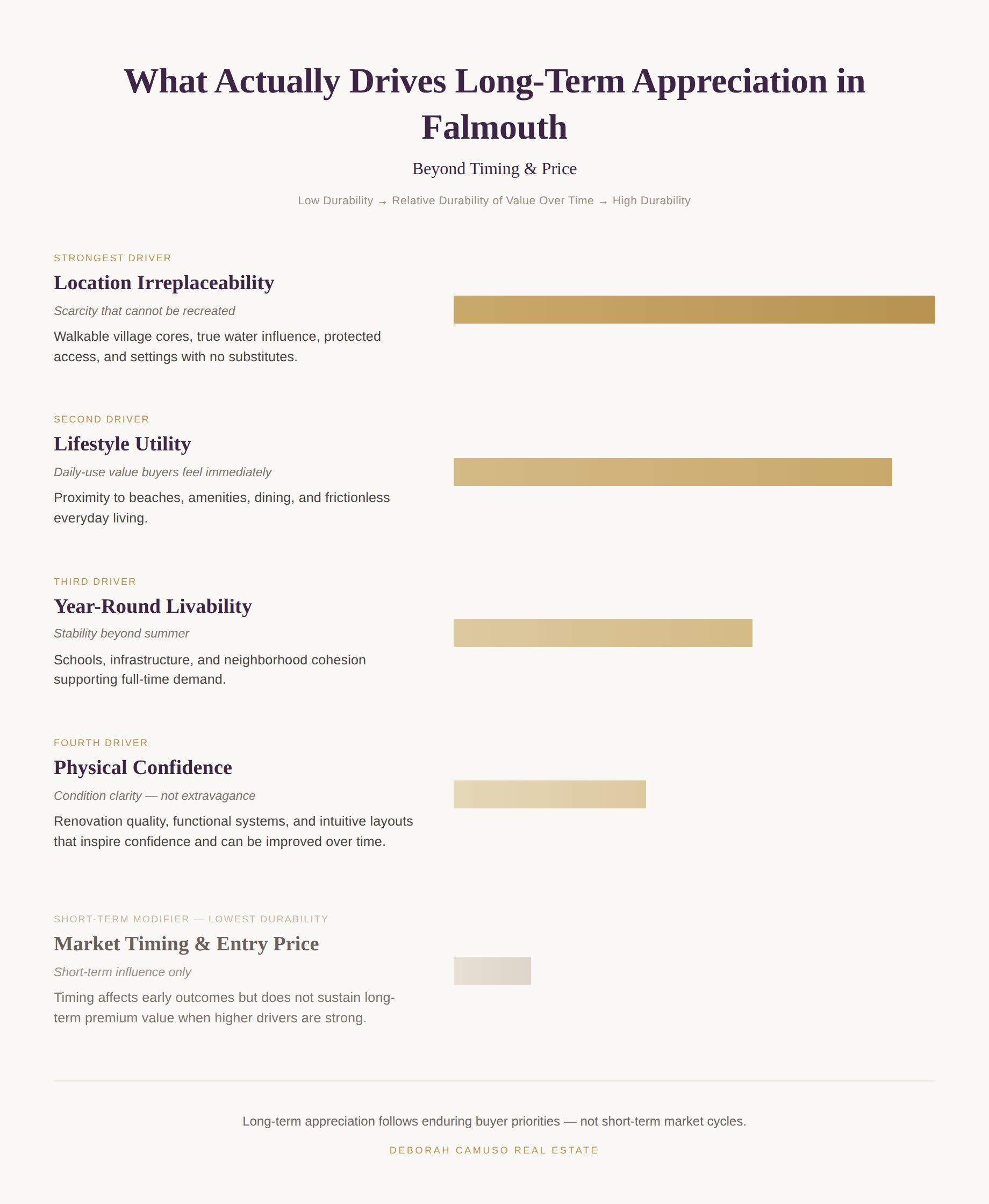
To understand why, we need to separate short-term market modifiers from durable appreciation drivers.
This second visual breaks down appreciation into relative durability over time, ranked from strongest to weakest influence.
Let’s walk through each driver — and how it shows up in Falmouth specifically.
This is the single most powerful appreciation factor in Falmouth.
Irreplaceable locations share traits that cannot be recreated:
True village walkability
Protected or historic waterfront access
Deep harbor influence
Conservation boundaries
Established historic districts
Examples include:
Woods Hole village core
Quissett Harbor
Falmouth Village near the Inner Harbor
Penzance Point
Chapoquoit and Sippewissett coastal pockets
These locations remain in constant demand across market cycles because supply is permanently constrained .
Lifestyle utility measures how immediately livable a location feels.
In Falmouth, this includes:
Walkable access to dining, beaches, marinas, and culture
Proximity to Shining Sea Bikeway
Ease of daily living without relying on a car
Villages like Downtown Falmouth, West Falmouth Village, and North Falmouth Village benefit here, especially when paired with water influence or village charm.
Lifestyle utility doesn’t just attract buyers — it widens the buyer pool, which directly supports price strength.
This driver separates resilient locations from purely seasonal ones.
Year-round livability includes:
Schools and community infrastructure
Stable neighborhoods
Access to services beyond summer months
Areas such as North Falmouth, East Falmouth (inland sections), Waquoit, and Teaticket perform well here, particularly for families and full-time residents .
These locations may not command peak summer premiums, but they often deliver steady, durable appreciation over time.
Physical confidence refers to how clear and functional a home feels to buyers — not extravagance.
Buyers consistently reward:
Solid systems
Intuitive layouts
Renovations that respect scale and context
Importantly, physical confidence is improvable, unlike location. It can enhance value, but it rarely overrides a weak micro-location.
This is the most misunderstood factor.
Market timing affects initial outcomes, but it does not sustain long-term premium value when higher drivers are absent.
Homes in irreplaceable locations recover faster after corrections.
Homes without those traits often do not — regardless of when they were purchased.
If you’re buying in Falmouth with appreciation in mind:
Prioritize overlapping demand zones shown in Visual 1
Choose irreplaceable micro-locations over larger homes in weaker areas
View market timing as a modifier, not a strategy
Buyers:
If you’d like help evaluating specific streets, harbors, or village pockets through this framework, Deb would love to walk you through real examples and current inventory that align with long-term value. Call or email anytime!
Sellers:
Understand which appreciation drivers your property already owns
Price based on durable demand, not last cycle’s peak
Position your home around why buyers stay interested over time:
Deb offers a forensic, micro-location-based pricing and positioning review that goes far beyond generic CMAs — Reach out anytime to get the true value of YOUR property...
Falmouth rewards clarity.
When buyers understand why certain locations endure — and sellers align pricing with those realities — transactions become smoother, pricing becomes smarter, and long-term outcomes improve.
Long-term appreciation doesn’t follow hype.
It follows enduring buyer priorities.
508-335-3875





Deborah would love an opportunity to talk with you and show you why it would be a benefit to work with her. In a world full of uncertainty, she will guide you in the correct direction and ensure that you make the most confident decisions. Connect with Deborah - She is here to offer insight and support whenever you are ready.
Work With Deborah