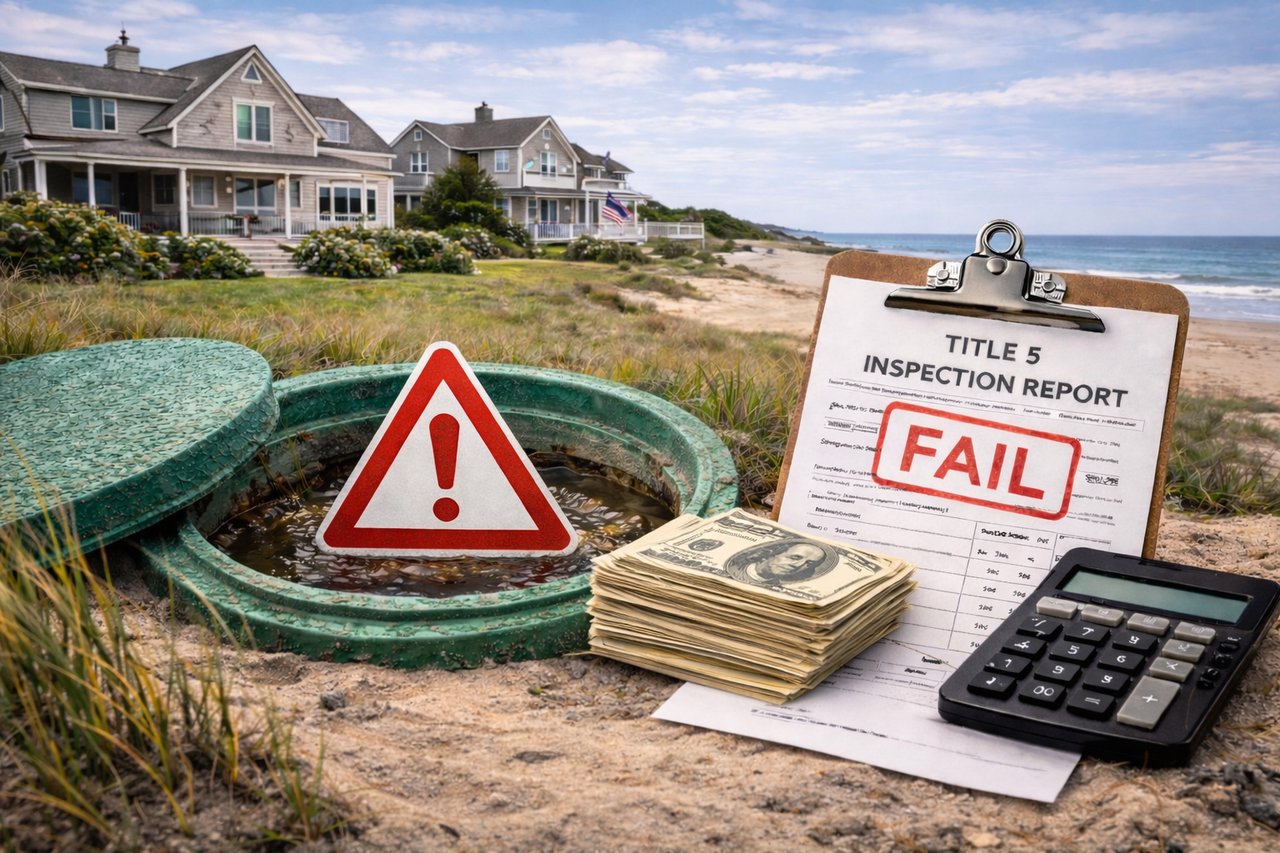
Cape Cod Septic Systems & Title 5: How to Avoid $30K+ Failures When Buying or Selling
Cape Cod's Title 5 regulations changed dramatically in July 2023 with new nitrogen-sensitive area requirements affecting 30 watersheds across all 15 towns. Between standard septic inspections required for every sale, potential failures costing $16,000 to $50,000+ to fix, new innovative/alternative systems mandating $32,000-$45,000 upgrades in designated areas, and expanded tax credits now reaching $18,000, buyers and sellers face complex decisions requiring expert guidance to avoid catastrophic financial mistakes.
Standard Requirements (All Properties):
NEW Nitrogen-Sensitive Area Requirements (July 2023):
Financial Assistance Available:
Key Dates:
Source: Massachusetts Department of Environmental Protection, 310 CMR 15.000, analyzed January 12, 2026
IMPORTANT DISCLAIMER
This guide provides general information about Title 5 septic systems and Massachusetts regulations as of January 2026. It is NOT a substitute for professional advice. Septic regulations are complex, constantly evolving, and vary by town and property location. Information in this guide may become outdated as regulations, costs, and requirements change.
ALWAYS consult with:
Deborah Camuso and debcamuso.com assume no liability for decisions made based on this content. Use this information as a starting point for research, not as definitive guidance for your specific situation.
If you're buying a Cape Cod home with a septic system, you're facing inspection requirements that could reveal a $30,000+ problem hours before closing. If you're selling, a failed Title 5 inspection can derail your transaction, force you into emergency upgrades, or cost you tens of thousands negotiating with buyers who now hold all the leverage. And if your property falls within one of Cape Cod's 30 newly designated nitrogen-sensitive areas, you're navigating an entirely new regulatory framework that most agents don't understand yet.
As of January 12, 2026, Deborah Camuso has analyzed every aspect of Cape Cod's Title 5 requirements—both the standard inspection rules that have governed sales for decades and the transformative July 2023 regulations addressing nitrogen pollution in coastal watersheds. This complete guide explains what buyers and sellers actually need to know: when inspections are required, what they cost, how the new nitrogen-sensitive area rules work, who pays when systems fail, what financial assistance exists, and how to negotiate intelligently whether you're buying or selling.
The stakes are real. Cape Cod has approximately 85% of wastewater disposal through septic systems rather than municipal sewers, making Title 5 compliance unavoidable for most transactions. Standard system replacements run $15,000-$25,000. Nitrogen-reducing innovative/alternative systems required in designated areas cost $32,000-$45,000 for a typical 3-bedroom home. Failed inspections discovered during purchase-and-sale periods create crisis negotiations where unprepared parties make expensive mistakes. Understanding these requirements before you list or before you make an offer determines whether you protect yourself or get hurt financially.
Title 5 refers to section 310 CMR 15.000 of the Massachusetts State Environmental Code, which governs the siting, design, construction, installation, inspection, and maintenance of all on-site septic systems statewide. The regulations were enacted in 1995 primarily to protect public health by ensuring septic systems don't create sanitary hazards—sewage backing up into homes, effluent surfacing in yards, or contamination entering drinking water supplies.
For Cape Cod specifically, Title 5 takes on additional environmental urgency because the Cape's porous sandy soils allow nutrients from septic systems to travel quickly into groundwater and eventually into bays, harbors, and estuaries. With 85% of Cape properties using septic rather than municipal sewers, the accumulated nitrogen from hundreds of thousands of systems has created severe coastal water quality degradation: toxic algae blooms, beach closures, declining shellfish harvests, loss of eelgrass beds, and economic impacts to tourism and property values.
The July 7, 2023 amendments to Title 5 specifically target this nitrogen pollution problem by creating nitrogen-sensitive area designations and requiring either community-wide watershed management plans or individual property upgrades to nitrogen-reducing septic technology. These changes represent the most significant shift in Massachusetts septic regulation in three decades, fundamentally altering how Cape Cod buyers and sellers approach real estate transactions involving septic systems.
Understanding Title 5 means understanding two parallel regulatory frameworks: the standard inspection and upgrade requirements that apply to all septic systems across Massachusetts, and the new nitrogen-focused requirements that apply specifically to properties within Cape Cod's designated nitrogen-sensitive areas. Both matter for your transaction.
Regardless of nitrogen-sensitive area status, every Cape Cod property with a septic system faces standard Title 5 inspection requirements that have been in effect since 1995. Here's what applies to your transaction:
When Title 5 Inspections Are Required
A Title 5 inspection must be completed within 2 years before the property transfers ownership, or within 3 years if the system has been pumped annually and pumping records are available. The inspection report remains valid for 2 years (or 3 years with annual pumping documentation), meaning if you inspected in 2024 and the system passed, you can sell anytime through 2026 without re-inspection.
Weather can complicate timing. If conditions prevent inspection before closing—frozen ground in winter, saturated soil after heavy rain—the inspection can occur within 6 months after the sale closes, provided the seller notifies the buyer in writing before closing that post-closing inspection will be required. This "6 months after" provision exists specifically to accommodate Cape Cod's challenging seasonal conditions.
There are limited exemptions. You do NOT need a Title 5 inspection when: refinancing a mortgage or any transaction where no new parties are introduced; transferring property in estate planning or divorce where no new owners enter; transferring to immediate family in certain circumstances; or selling a property where a new system was installed and received a Certificate of Compliance within the past 2 years. For all other sales, Title 5 inspection is mandatory.
What The Inspection Actually Examines
A licensed Title 5 inspector (you can find approved inspectors through your town's Board of Health or the MassDEP website) conducts a comprehensive evaluation of your entire septic system. This includes: locating and exposing the septic tank, distribution box, and leaching field components; measuring sludge and scum layers in the tank; testing all household fixtures (every toilet, sink, shower, dishwasher) to verify they drain properly; evaluating groundwater elevation relative to the leaching field; checking for leaks, cracks, or structural damage in tanks and pipes; assessing whether the system shows signs of hydraulic failure (backup, surface breakout, or insufficient drainage); and verifying the system meets Title 5 design standards for the property's bedroom count and use.
The inspector produces a detailed report describing system components, their condition, test results, and whether the system passes Title 5 requirements. This isn't a pass/fail based on age—a 40-year-old system can pass if it's functioning properly, while a 10-year-old system can fail if it's showing hydraulic failure or environmental contamination.
The Four Possible Inspection Outcomes
Your Title 5 report will show one of four results:
Pass: The system meets all Title 5 requirements and shows no evidence of failure. Transactions proceed normally. This is what everyone hopes for.
Conditional Pass: The system generally functions but has components needing repair or replacement—perhaps a cracked distribution box, damaged baffles, or a tank cover requiring replacement. These are typically $1,000-$5,000 repairs. The system can continue operating, but identified repairs should be completed. Buyers and sellers negotiate who handles repairs and timing.
Fail: The system exhibits hydraulic failure (sewage backing up, effluent surfacing, or inadequate treatment) or poses environmental/health threats. This triggers the 2-year repair requirement and creates significant transaction complications. Replacement costs range from $15,000-$50,000+ depending on system type and site conditions.
Needs Further Evaluation: The inspector identifies conditions requiring town Board of Health review—perhaps the system appears marginal, measurements are borderline, or local officials must interpret specific conditions. The Board of Health makes the final determination.
Failed inspections don't automatically kill transactions, but they shift negotiating leverage dramatically toward buyers and create urgent financial decisions for sellers.
Who Pays and When
Massachusetts law requires the seller to arrange and pay for the Title 5 inspection. However—and this is critical—the law does NOT require sellers to pay for repairs or system replacement if the inspection fails. The seller's only legal obligation is obtaining the inspection and providing results to the buyer.
What happens with a failed system is entirely negotiable. Common approaches include: seller completes repairs/replacement before closing; seller reduces sale price by the repair cost; buyer and seller split costs; parties establish an escrow account at closing to fund post-closing repairs; or buyer accepts the system "as-is" with Board of Health agreement to complete repairs within 2 years. Some lenders won't allow "as-is" sales with failed septics or septic escrows, making seller-completed repairs the only viable path.
Smart sellers inspect early—before listing—so they know what they're facing and can either complete repairs proactively or price the property accounting for known issues. Discovering a failed system during the purchase-and-sale period creates crisis negotiations where sellers have minimal leverage.
On July 7, 2023, Massachusetts Department of Environmental Protection implemented the most significant changes to Title 5 regulations in decades, specifically targeting nitrogen pollution in Cape Cod's coastal watersheds. These changes create an entirely new regulatory layer affecting tens of thousands of Cape properties.
What Are Nitrogen-Sensitive Areas?
MassDEP designated 30 watersheds across all 15 Cape Cod towns as nitrogen-sensitive areas (NSAs) based on documented nitrogen impairment to embayments and estuaries. These aren't arbitrary designations—they're watersheds where decades of septic system discharge has caused measurable ecological damage including toxic algae blooms, oxygen depletion killing fish and shellfish, loss of eelgrass beds, and beach closures.
Every town on Cape Cod has at least some properties within designated NSAs. Barnstable, Falmouth, Yarmouth, Dennis, Harwich, Chatham, Orleans, Brewster, Eastham, Wellfleet, Truro, Provincetown, Sandwich, Bourne, and Mashpee all have NSA watersheds affecting residential properties. Whether your specific property falls within an NSA is determinable through the MassDEP NSA map or tools like CCIAOR's NSA lookup.
Traditional septic systems remove bacteria and organic matter but do virtually nothing to remove nitrogen. The nitrogen from human waste passes through the system and enters groundwater, eventually flowing into coastal waters. In areas with high septic density—like Cape Cod's 85% septic reliance—this accumulated nitrogen load overwhelms the ecosystem's natural ability to process nutrients.
The Watershed Permit Option: Community Solutions
The regulations give Cape towns a choice: pursue a watershed permit allowing community-wide nitrogen management approaches, or face property-by-property mandates requiring individual homeowners to upgrade to nitrogen-reducing septic systems.
A watershed permit is essentially a 20-year plan where the town commits to reducing nitrogen loads through various strategies that might include: expanding municipal sewers; installing centralized treatment systems; requiring innovative/alternative septic systems in strategic locations; implementing permeable reactive barriers; restoring wetlands and cranberry bogs that absorb nitrogen; promoting aquaculture that consumes nitrogen; reducing fertilizer use; or combining multiple approaches tailored to each watershed's specific conditions.
Towns had 2 years from July 7, 2023 to file a Notice of Intent to pursue watershed permits. The good news: as of July 2025, all 15 Cape towns filed Notices of Intent, meaning every Cape community is pursuing the watershed permit approach rather than imposing immediate mandates on individual homeowners. This doesn't eliminate nitrogen requirements—it shifts them to community-scale solutions implemented over 20 years rather than 5-7 year individual mandates.
However, watershed permits aren't automatic. Towns must develop comprehensive plans, secure MassDEP approval, demonstrate measurable nitrogen reduction progress, and maintain compliance throughout the 20-year permit term. If a town's watershed permit application is rejected or if the town fails to maintain permit compliance, the regulations revert to individual property mandates.
What Happens If Watershed Permits Fail
If a watershed loses its permit or a town's permit application is denied, properties within that NSA face mandatory upgrades to Best Available Nitrogen Reducing Technology (BANRT), typically innovative/alternative (I/A) septic systems providing 50%+ nitrogen reduction compared to conventional systems.
The timeline is 7 years from July 7, 2023, meaning upgrades would be required by July 2030 if watershed permits fail. Some regulatory interpretations reference 5-year timelines once a watershed approach is definitively rejected, creating some ambiguity about exact deadlines. The critical point: individual mandates only trigger if community watershed approaches fail.
New construction in NSAs faces stricter rules. Six months after July 7, 2023 (meaning January 2024 onward), any new septic system installed in an NSA must include nitrogen-reducing technology unless the town has filed for a watershed permit. This means new homes or major renovations triggering septic replacement must install I/A systems even while existing homes can maintain conventional systems under watershed permit protection.
Homeowners who proactively installed I/A systems in the 10 years before July 2023 get credit—they won't face mandatory upgrades until those systems fail or the local Board of Health requires replacement. This rewards early adopters but doesn't create permanent exemptions.
How This Affects Your Real Estate Transaction
For buyers: If you're purchasing in an NSA (check the maps before making offers), understand that your town's watershed permit provides current protection from individual mandates, but there's no guarantee the permit will survive 20 years. You're buying potential future upgrade risk. Factor this into your offer price and negotiation strategy.
If the property already has an I/A system, that's valuable—you're protected regardless of watershed permit outcomes. If it has a conventional system, you're relying on the town's watershed permit success. Some buyers negotiate price reductions accounting for potential future nitrogen upgrade costs ($32,000-$45,000), while others accept the risk believing watershed permits will succeed.
For sellers: If you're in an NSA with a conventional system, sophisticated buyers will raise nitrogen upgrade concerns. Your response depends on the town's watershed permit status. If your town filed a Notice of Intent and is actively pursuing a permit (all 15 Cape towns are), you can argue there's no immediate mandate and watershed solutions will likely eliminate individual requirements. If your town's permit faces challenges, expect buyers to demand price concessions.
If you've already installed an I/A system, that's a selling point—advertise the nitrogen-reducing technology as eliminating future mandate risk. Some sellers proactively upgrade to I/A systems before listing in NSAs, using the upgraded system as a competitive advantage and potentially capturing tax credits (see financing section below).
Understanding costs matters whether you're a seller facing a failed inspection or a buyer negotiating who pays for upgrades. Cape Cod septic costs vary by system type, bedroom count, soil conditions, and site access, but here are realistic 2026 ranges based on actual Cape installations:
Inspection Costs
Title 5 inspections cost $400-$900 across Massachusetts, with Cape Cod typically falling in the $500-$800 range. Factors affecting cost include: property size and bedroom count (larger systems cost more to inspect); system accessibility (buried or hard-to-reach components increase labor); whether pumping is required before inspection (some inspectors include pumping, others charge separately); and whether you need expedited service (rush inspections carry premiums).
Plan to add $250-$500 for septic pumping if not included in your inspection quote. Most inspectors require or strongly recommend pumping before inspection to properly evaluate tank conditions, measure sludge/scum layers, and check baffles and outlets. Skipping pumping risks incomplete inspections requiring follow-up visits.
Re-inspection after repairs typically costs $200-$400. If you complete recommended repairs on a conditional pass or fix specific components on a failed system, the inspector returns to verify compliance and issue an updated report.
Conventional System Replacement
For a standard conventional septic system outside nitrogen-sensitive areas or where I/A systems aren't mandated, expect approximately $5,300 per bedroom for design, permitting, installation, and final inspection. This means:
These are baseline estimates for typical Cape Cod soil conditions, standard tank sizes, and reasonable site access. Costs increase significantly if you face: high groundwater requiring mounded systems or pump chambers; ledge or difficult soils requiring blasting or special excavation; tight site constraints limiting leaching field placement; long distances from house to suitable drainage area; or local requirements exceeding minimum Title 5 standards.
The process includes: soil testing and percolation tests ($500-$1,500); engineering design submitted to Board of Health ($1,500-$3,000); Board of Health permit fees ($200-$800 depending on town); excavation and installation labor (largest cost component); tanks, pipes, and materials; final inspection and Certificate of Compliance. Add 10-20% contingency for unexpected site conditions that frequently emerge during excavation.
Innovative/Alternative (I/A) Nitrogen-Reducing Systems
For properties in nitrogen-sensitive areas facing mandates if watershed permits fail, or for sellers/buyers choosing to upgrade proactively, I/A systems providing 50%+ nitrogen reduction cost approximately double conventional systems.
Typical Cape Cod I/A system costs:
I/A systems use various technologies—packed bed filters, fixed film reactors, aerobic treatment units, or other MassDEP-approved designs—that provide enhanced nitrogen removal through biological treatment processes. They require electricity to operate (adding $20-$50 monthly to utility costs), more frequent maintenance than conventional systems (annual or semi-annual servicing), and periodic component replacement (media, blowers, pumps) over their lifespan.
The benefit: I/A systems satisfy nitrogen-sensitive area mandates if watershed permits fail, qualify for enhanced tax credits (see below), and provide marketing advantages when selling in NSAs by eliminating buyers' future upgrade concerns.
Best Available Technology (BAT) Systems
For properties requiring maximum nitrogen reduction—whether due to specific site conditions, local Board of Health mandates, or homeowner choice—BAT systems achieving 75%+ nitrogen removal cost approximately:
BAT represents the most advanced nitrogen-reducing technology currently available. Few Cape properties face BAT mandates today, but some environmentally sensitive sites near impaired water bodies or within critical watersheds may require BAT rather than standard I/A systems. Costs reflect more sophisticated treatment technology, higher material costs, and more complex installation requirements.
Hidden Costs and Timeline
Beyond direct system costs, factor in: landscaping restoration after installation ($1,000-$5,000 depending on damage); driveway or hardscape repair if excavation requires crossing paved areas ($2,000-$10,000); temporary living arrangements if the system fails catastrophically and the home becomes uninhabitable (rare but possible); opportunity costs if a failed system delays or derails your sale; and financing costs if you need to borrow for the replacement.
Timeline matters for transaction planning. From initial failure discovery to Certificate of Compliance typically requires 3-4 months: 2-4 weeks for engineering and design; 2-4 weeks for Board of Health permit review; 4-8 weeks for installation once approved (weather-dependent); and 1-2 weeks for final inspection and COC. Emergency situations with imminent health hazards can sometimes accelerate permitting, but you can't reliably count on fast-tracking.
The financial hit from septic replacement—$16,000 for conventional, $32,000-$45,000 for I/A systems—can be devastating. Massachusetts and Cape Cod entities provide substantial financial relief that buyers and sellers should understand and negotiate over.
Massachusetts Septic Tax Credit
The state's Title 5 credit (Massachusetts General Laws Chapter 62, Section 6(i)) allows property owners to claim personal income tax credits for septic repairs, replacements, nitrogen-reducing upgrades, or sewer connections required by Title 5 regulations or watershed permits.
The credit was dramatically expanded in recent years. Previously capped at $6,000 total with $1,500 annual maximum, the credit now reaches $18,000 total with $4,000 annual maximum. This tripling of available credits directly responds to the nitrogen-sensitive area mandates requiring expensive I/A system installations.
Eligibility requirements are specific:
The refundable vs. non-refundable distinction matters significantly. If this is your primary Cape Cod residence, credits above your tax liability get refunded to you—real money back. If it's a second home or investment property, credits only reduce your tax liability and unused credits carry forward up to 5 years.
Qualifying expenditures include: system design and engineering; permits and Board of Health fees; excavation and installation labor; tanks, components, and materials; I/A system technology and equipment; sewer connection costs if mandated; and related compliance costs. Regular maintenance and pumping don't qualify—only mandated upgrades.
Cape Cod AquiFund
Barnstable County administers the Cape Cod AquiFund (formerly Community Septic Management Loan Program), providing 4% interest loans to qualified Cape Cod homeowners for septic system repairs, replacements, I/A system installations, and municipal sewer connections.
Loan benefits include: below-market interest rates (4% when conventional mortgages exceed 6-7%); loan amounts covering full project costs including engineering and incidental repairs; flexible terms up to 20 years; no early prepayment penalties; and loans secured as property liens that stay with the home through ownership changes.
The AquiFund has provided over $52.5 million in loans to more than 4,550 Cape properties since inception. This isn't a tiny, underfunded program—it's a robust financing mechanism specifically designed to address Cape Cod's septic challenges.
Application requirements include: completed application form; most recent federal tax return (Form 1040); current mortgage statement; and, for failed systems, a Title 5 inspection report showing failure. Approval typically occurs within 48 hours for straightforward applications, though complex situations may require additional review.
The program covers septic repairs, replacements, I/A installations, and sewer connections, including incidental work like landscaping restoration, driveway repairs, and required plumbing modifications. You can start soliciting contractor bids as soon as your system is inspected and certified failed—you don't need loan approval before getting quotes.
Important note: Septic repairs, replacements, and I/A installations are ONLY eligible for 4% interest loans. They are NOT eligible for the program's 0% or 2% interest rates, which are reserved for other environmental upgrades. This is still excellent financing compared to home equity loans, credit cards, or cash-out refinancing at higher rates.
Combining Tax Credits and Financing
Smart homeowners stack these benefits. Use AquiFund's 4% loan to finance the $32,000 I/A installation without depleting savings. Claim $4,000 tax credit each year for up to 5 years, receiving up to $18,000 back from the state (if primary residence with refundable credits). Net cost after credits: $14,000 instead of $32,000 out of pocket.
In real estate transactions, negotiate who gets to claim the credits based on who pays for work and when it's completed. If the seller completes the upgrade before closing, seller claims credits. If the buyer takes possession and completes work post-closing, buyer claims credits. If you establish an escrow where buyer completes work but seller funds it, negotiate explicitly who claims the credits—it may depend on whose tax situation benefits most.
Some sophisticated transactions involve seller-paid installations completed after closing (seller retains contractor relationship and writes checks) so seller captures tax credits offsetting their costs, while buyer gets the upgraded system. Tax professionals should structure these arrangements to ensure compliance and optimal credit allocation.
If you've never experienced a Title 5 inspection, here's what sellers and buyers can expect:
The seller (or seller's agent) contacts a licensed Title 5 inspector—get referrals from your Board of Health, real estate attorney, or trusted contractors. Avoid inspectors who also perform septic installations, as this creates conflicts of interest. Massachusetts specifically warns against inspectors financially connected to installation companies.
Scheduling typically requires 2-4 weeks' advance notice during busy summer months, though spring and fall often allow faster turnaround. The seller should schedule inspection early in the listing process, not wait until under contract.
Before the inspector arrives, homeowners should: locate property plans showing septic system location (if available); clear access to the suspected septic tank area (remove snow, vehicles, landscaping); arrange to be present during inspection to answer questions; ensure all household water fixtures are accessible; and consider having the tank pumped beforehand if it hasn't been serviced recently (though many inspectors include pumping).
The inspection day involves:
The entire process typically takes 2-4 hours depending on system size, accessibility, and complexity. Inspectors must expose and examine components directly—they can't rely solely on surface observations or homeowner reports.
Within 5-10 business days, you receive the written Title 5 inspection report. This is the official document you'll provide to buyers, lenders, and attorneys. The report includes: system location diagram; component descriptions and conditions; test results and measurements; pass/fail determination; required repairs if applicable; and inspector's signature and license number.
If the system passes, celebrate and provide the report to your buyer. If it receives a conditional pass, get quotes for recommended repairs and negotiate with buyers about timing and responsibility. If it fails, you're facing the decisions outlined in the negotiation section below.
A failed Title 5 creates urgency and forces difficult decisions. Here's what sellers and buyers face:
Seller's Decision Tree
When your pre-listing inspection fails, you have several paths:
Option 1: Complete repairs before listing. This is often the cleanest approach. You control the contractor selection, timeline, and quality. You pay market rate rather than inflated "emergency repair" pricing. You can claim any available tax credits. And you list with a passing system, eliminating buyer concerns and financing obstacles. Downsides: significant upfront cash outlay ($16,000-$45,000+) and 3-4 month timeline before you can list.
Option 2: List with disclosed failure and reduce price. You disclose the failed inspection upfront, reduce your asking price by the estimated repair cost (plus buffer for buyer risk), and sell "as-is." This attracts cash buyers and investors but eliminates many conventional buyers whose lenders won't approve loans on failed systems. You get out faster but leave money on the table.
Option 3: List at full price and negotiate when buyer emerges. This approach hopes buyers won't demand full repair costs, instead negotiating smaller concessions. It works best when inventory is tight and multiple buyers are competing. Risk: buyers discover the failure during due diligence when you have limited leverage, and negotiations occur under transaction deadlines.
Option 4: Board of Health agreement approach. In some situations, you and the buyer can execute an enforceable agreement with the Board of Health committing to complete repairs within 2 years post-closing. The buyer takes ownership with a failed system and legal obligation to upgrade. This requires buyer willingness to take on the project and often involves escrow holdbacks or price reductions ensuring repair funds are available.
Buyer's Response Strategy
When inspection reveals a failed system during your purchase process, you have leverage but must use it wisely:
Response 1: Request seller complete repairs before closing. This is cleanest for you. Seller pays, supervises work, resolves any installation issues, and delivers a passing system with Certificate of Compliance. You close confident the system is functional. The seller may counter-offer with a price reduction instead—evaluate whether managing the project yourself is worth the discount.
Response 2: Negotiate price reduction equal to repair cost. If seller won't complete repairs, demand a price reduction covering the full replacement cost plus 15-20% contingency for unexpected conditions. You take possession, use the savings to fund repairs post-closing, and possibly capture tax credits if you're making it your primary residence. Verify your lender will approve this approach—many won't loan on properties with failed Title 5.
Response 3: Split costs through escrow. Establish a repair escrow at closing where seller funds the estimated cost (or portion thereof), you take possession and hire contractors, complete work within agreed timeframe (typically 6-12 months), and remaining escrow funds are released upon Certificate of Compliance. This shares risk—seller contributes financially, you control the work. Again, confirm lender acceptance.
Response 4: Accept "as-is" with Board of Health agreement. If you're paying cash or have lender approval, you can accept the property with failed system and signed Board of Health agreement requiring repair within 2 years. This works if you're planning renovations anyway and can incorporate septic replacement into your construction project. Negotiate significant price reduction reflecting the $16,000-$45,000 liability you're assuming.
Response 5: Walk away. If the seller won't negotiate reasonably and you're not comfortable assuming repair responsibility, terminate during your inspection contingency period. Failed septics are legitimate deal-killers, especially for buyers relying on conventional financing.
Conditional Pass Negotiations
Conditional passes occupy middle ground—the system functions but needs specific repairs. Common conditional pass items include:
Buyers should request seller complete conditional repairs or reduce price by repair costs. Sellers should evaluate whether completing minor repairs (under $5,000) is worth maintaining buyer goodwill and transaction momentum versus risking buyer walkaway over a few thousand dollars.
If your property falls within one of Cape Cod's 30 designated NSAs, negotiations take additional dimensions beyond standard Title 5 compliance:
When Watershed Permits Provide Protection
Since all 15 Cape towns filed watershed permit applications by July 2025, most NSA properties currently benefit from permit protection, meaning no immediate I/A system mandates exist. Sellers in NSAs with conventional systems should emphasize this:
"The town filed its watershed permit application, which suspends individual homeowner mandates. The town's 20-year plan addresses nitrogen reduction through community-wide approaches, and we're protected under that framework. There's no current requirement to upgrade this conventional system."
Buyers should counter with risk-based pricing:
"While the watershed permit provides current protection, there's no guarantee it will be approved or maintained for 20 years. If the permit fails, we're facing a $32,000-$45,000 upgrade mandate within 7 years. We're requesting a $15,000 price reduction to account for this risk."
The negotiation becomes a bet on watershed permit success. Sellers optimistic about town management strategies resist concessions. Buyers concerned about regulatory risk demand price protection. Market conditions—inventory levels, competing offers, buyer financing—determine who has leverage.
Properties Already With I/A Systems
If you're selling an NSA property where you've already installed an I/A system, market this aggressively:
"This property features a 2022-installed nitrogen-reducing innovative/alternative septic system providing 50%+ nitrogen removal. Regardless of watershed permit outcomes, this system satisfies all NSA requirements and eliminates buyer risk of future upgrade mandates. Original installation cost $34,000; buyer is receiving this upgraded system as part of purchase."
Buyers should verify the I/A system is properly permitted, maintained per manufacturer specifications, and actually provides the claimed nitrogen reduction. Request maintenance records, manufacturer documentation, and Board of Health permits confirming it's an approved system.
Don't automatically pay premium prices for I/A systems unless watershed permit failure seems likely. If the town's watershed permit appears solid, paying extra for an I/A system that may not be required for decades doesn't make economic sense. Evaluate based on your assessment of permit risk.
New Construction Nitrogen Requirements
Remember that new septic installations in NSAs (since January 2024) must include nitrogen-reducing technology regardless of watershed permits. If you're buying NSA land planning to build, or buying a home requiring major renovation triggering septic replacement, factor I/A costs into your construction budget.
Sellers of vacant NSA land should disclose nitrogen requirements so buyers understand that any future septic installation will cost $32,000+ rather than $16,000 for conventional systems. Buyers overpaying for land without accounting for I/A installation costs face nasty surprises when obtaining building permits.
If you're buying Cape Cod property with septic, follow this strategic approach:
Before making offers: Confirm whether the property has septic or municipal sewer. Check if it's in a nitrogen-sensitive area using MassDEP's NSA map or CCIAOR tools. If it's in an NSA, research the town's watershed permit status—contact the Board of Health or town environmental department. Factor potential septic costs into your maximum offer price, especially for older homes that may need replacement soon.
During offer and negotiation: Include strong inspection contingencies allowing you to conduct Title 5 inspection and terminate if results are unsatisfactory. Don't waive inspection contingencies even in competitive markets—failed septics create financing obstacles you can't overcome. If making offers on multiple properties, schedule Title 5 inspections quickly so you can make informed decisions while under contract on several homes.
After inspection results: If the system passes, proceed confidently. If conditional pass, decide whether recommended repairs concern you and negotiate accordingly—minor items under $3,000 shouldn't derail deals. If failed, immediately obtain repair quotes from 2-3 licensed installers to establish realistic costs, then negotiate based on actual numbers, not estimates.
Negotiation positioning: If the seller resists reasonable repair or price reduction requests, emphasize financing challenges: "My lender requires passing Title 5 for loan approval. Without seller-completed repairs or significant price reduction, I cannot obtain financing." This frames the issue as a transaction necessity rather than buyer demands.
NSA-specific strategies: For NSA properties with conventional systems, negotiate price reductions between $10,000-$20,000 if watershed permit outcomes seem uncertain. For NSA properties with existing I/A systems, verify proper installation and maintenance before paying premiums. For NSA new construction or major renovations, ensure your construction budget includes $32,000-$45,000 for required I/A systems.
Financial planning: If taking on repair responsibility, immediately apply for AquiFund financing—don't wait until closing. Confirm whether you'll qualify for refundable tax credits (primary residence) or non-refundable credits (second home). Plan repair timelines accounting for 3-4 month completion windows. Ensure you have contingency funds for unexpected complications during installation.
Red flags to watch: Avoid properties where sellers claim "the septic is fine, I've never had problems" but refuse to provide Title 5 inspection results—this usually means they know it will fail. Be wary of "recently pumped" systems sold without inspection—pumping isn't the same as passing Title 5. Question properties sold "as-is" with no Title 5—sellers may be hiding known failures.
If you're selling Cape Cod property with septic, strategic planning prevents disasters:
6-12 months before listing: Schedule Title 5 inspection well before you're ready to list. This gives you time to address failures without transaction deadline pressure. If the system passes, celebrate—you have 2 years to sell without re-inspection. If it fails, you have time to explore repair options, get multiple bids, complete work before listing, or adjust your pricing strategy accordingly.
If inspection passes: Provide the passing report to your listing agent for inclusion in property marketing. Advertise "passing Title 5 inspection completed [date]" as a selling point. Maintain the report carefully—you'll need copies for buyers, attorneys, and lenders. Schedule your listing and closing to occur within the report's 2-year (or 3-year) validity period.
If inspection fails: Get repair quotes immediately from 2-3 licensed installers to establish realistic costs. Decide whether to complete repairs before listing (cleanest approach, requires upfront capital), list with disclosed failure and reduced price (fastest exit, lowest net proceeds), or list at full price planning to negotiate (risky, may create transaction crises).
If choosing pre-listing repairs: Interview contractors carefully—check references, verify licenses, review past work. Understand design requirements for your property's bedroom count and soil conditions. Secure Board of Health permits before work starts. Plan 3-4 month timeline from permit application to Certificate of Compliance. If installing I/A systems in NSAs, apply for AquiFund financing and position yourself to capture tax credits. Complete work and obtain COC before listing.
If listing with known failure: Disclose the failed inspection upfront in your listing description and property disclosure forms—hiding it creates legal liability and transaction implosions. Reduce your asking price by estimated repair costs plus 15-20% buyer risk premium. Market to cash buyers and investors who can close without conventional financing. Provide repair quotes from licensed installers so buyers understand actual costs. Be prepared for low offers—failed septics significantly reduce your buyer pool.
During negotiations: If buyers discover failure during inspection period, expect tough negotiations. Have current repair quotes ready to establish costs. Offer solutions: complete repairs yourself, provide price reductions, establish repair escrows, or execute Board of Health agreements. Don't dismiss buyer concerns as unreasonable—failed septics are legitimate transaction obstacles.
NSA considerations: If selling in NSAs, research your town's watershed permit status before listing. If the permit is secure, emphasize this to buyers concerned about future I/A mandates. If the permit faces challenges, consider proactive I/A installation before listing—you capture tax credits, market the upgraded system, and eliminate buyer uncertainty.
Tax credit optimization: If completing repairs or I/A installations, understand you'll claim credits on your next few tax returns. If this is your primary residence, refundable credits provide cash back. If it's a second home or investment property, non-refundable credits reduce your tax liability. Plan timing strategically—if you're selling in December, completing work in January may allow the buyer to claim credits instead.
Documentation discipline: Maintain meticulous records of all septic work—permits, inspection reports, contractor invoices, Certificate of Compliance, maintenance logs, and pumping records. Buyers, attorneys, and lenders will request these. Missing documentation creates transaction delays and buyer concerns about system legitimacy.
Q: How long is a Title 5 inspection valid?
A: Two years from the inspection date, or three years if the system was pumped annually after inspection and you have documentation. If you inspected in March 2024 and it passed, you can sell anytime through March 2026 without re-inspection. After that period, you need a new inspection before selling.
Q: Can I sell my Cape Cod home without a Title 5 inspection?
A: Only in very limited circumstances: properties on municipal sewer (no septic); systems with Certificate of Compliance issued within past 2 years; transfers to immediate family in certain situations; refinancing or ownership changes where no new parties are introduced; and situations where buyer signs Board of Health agreement accepting responsibility for inspection. For standard sales, Title 5 is mandatory.
Q: Who pays for Title 5 inspection—buyer or seller?
A: Seller pays for the inspection. However, if the inspection reveals needed repairs or system failure, repair costs are negotiable between buyer and seller. Massachusetts law doesn't require sellers to fix failed systems, only to obtain the inspection and provide results.
Q: My property is in a nitrogen-sensitive area. Do I need to upgrade to an I/A system before selling?
A: Not currently, because all Cape towns filed watershed permit applications. Individual homeowner mandates are suspended while towns pursue community-wide nitrogen solutions under 20-year watershed permits. However, if your town's permit is rejected or fails, properties in NSAs face 7-year upgrade timelines. Buyers may negotiate price reductions accounting for this risk.
Q: How much does it cost to replace a failed septic system on Cape Cod in 2026?
A: Conventional system replacement averages $5,300 per bedroom, meaning $16,000 for a typical 3-bedroom home. Innovative/alternative nitrogen-reducing systems required in some NSAs cost approximately $32,000 for 3-bedroom homes. Best Available Technology systems can reach $45,000+. Actual costs vary based on soil conditions, site access, groundwater levels, and specific design requirements.
Q: Can I get financial assistance for septic replacement?
A: Yes, substantial assistance exists. Massachusetts offers tax credits up to $18,000 (refundable for primary residences, non-refundable for second homes). Cape Cod AquiFund provides 4% interest loans for septic repairs, replacements, I/A installations, and sewer connections. Many homeowners combine these programs, financing work with low-interest loans and recovering thousands through tax credits over subsequent years.
Q: What happens if my septic system fails inspection after I've accepted an offer?
A: This creates crisis negotiation. The buyer typically requests you complete repairs before closing, reduce the price by repair costs, or establish an escrow account funding post-closing repairs. Your leverage depends on market conditions and buyer alternatives. Many buyers will walk away if you refuse reasonable accommodation, especially if they need financing (most lenders won't approve loans on failed systems). Get multiple contractor quotes immediately to establish realistic costs and negotiate from informed positions.
Q: How long does it take to replace a failed septic system?
A: Plan for 3-4 months from failure discovery to Certificate of Compliance: 2-4 weeks for soil testing and engineering design, 2-4 weeks for Board of Health permit review, 4-8 weeks for installation (weather-dependent), and 1-2 weeks for final inspection and COC. Emergency situations with imminent health hazards sometimes accelerate, but you cannot reliably count on fast-tracking. This timeline is why sellers should inspect early, not wait until under contract.
Q: Do I need Title 5 inspection if I'm not selling but doing major renovations?
A: You need Title 5 compliance (not necessarily inspection) if your renovation increases design flow—primarily if you're adding bedrooms. Adding a bedroom requires septic system capacity verification and potential upgrades. If you're in a nitrogen-sensitive area and replacing your septic for any reason (failure, expansion, voluntary upgrade), new installations since January 2024 must include nitrogen-reducing technology.
Title 5 regulations affect virtually every Cape Cod real estate transaction involving septic systems—which is most of them, given the Cape's 85% septic reliance. The standard inspection requirements have been in place for decades: inspections within 2 years before sale, pass/fail/conditional outcomes, and 2-year repair windows for failures. These are well-established, and experienced Cape agents navigate them routinely.
The July 2023 nitrogen-sensitive area regulations introduce new complexity. Thirty watersheds across all 15 towns face nitrogen mandates that could require $32,000-$45,000 system upgrades if community watershed permits fail. All Cape towns filed permit applications, suspending individual mandates while towns pursue 20-year community solutions. Whether these permits succeed determines if individual homeowners face upgrade requirements or if community approaches eliminate property-by-property mandates.
For buyers, Title 5 means: inspect systems before closing, understand nitrogen-sensitive area status, factor repair costs into offers, negotiate intelligently when failures emerge, and utilize available financing (AquiFund) and tax credits ($18,000 maximum) to manage costs. Don't waive inspection contingencies, don't assume old systems will pass, and don't underestimate replacement costs.
For sellers, Title 5 means: inspect early (6-12 months before listing), address failures proactively when possible, disclose known issues honestly, price realistically if selling with known failures, and understand NSA implications if your property falls within designated watersheds. Don't hide septic problems hoping buyers won't notice—they will, and late discoveries destroy transactions and create legal liability.
The regulations exist to protect public health and Cape Cod's fragile coastal ecosystems. Nitrogen pollution threatens water quality, tourism, property values, and the environmental character that makes Cape Cod desirable. While compliance costs are significant, financial assistance through tax credits and low-interest loans makes systems more affordable. And ultimately, protecting the Cape's water quality protects everyone's property values long-term.
Navigate these requirements with professional guidance—licensed Title 5 inspectors, experienced Cape Cod real estate agents, real estate attorneys familiar with septic transactions, and tax professionals who understand credit eligibility. The money you spend on expert advice prevents the catastrophic mistakes that cost tens of thousands.
The numbers tell one story—$16,000 conventional replacements, $32,000-$45,000 nitrogen-reducing systems, $18,000 available tax credits, 2-year inspection validity, 7-year upgrade timelines for NSAs if watershed permits fail—but your specific situation tells another. Whether you're buying your first Cape home and need to understand Title 5 implications, selling a property with older septic and want to know your options, concerned about nitrogen-sensitive area requirements affecting your transaction, or trying to figure out who pays for what when systems fail during negotiations, the right strategy depends on factors the data alone can't capture.
If you're buying: The Title 5 report tells you system condition, but it doesn't tell you whether that conditional pass item is worth negotiating over, whether the seller's repair timeline is realistic given contractor availability, whether your lender will accept the proposed escrow structure, or how to evaluate nitrogen mandate risk if you're in an NSA. Let's talk about what you're looking at, what your inspection revealed, where you have leverage, and how to structure offers and negotiations that protect your interests while keeping transactions moving forward.
If you're selling: Your inspection results tell you pass/fail status, but they don't tell you whether completing repairs before listing is worth the 3-4 month delay, how to price a property with disclosed failure to attract buyers without leaving money on the table, whether your NSA location creates negotiation exposure, or how to handle buyer repair demands during transaction deadlines. Let's walk through your options, discuss timing strategies, evaluate whether proactive I/A installation makes sense in your NSA location, and position you to close at the best possible price while avoiding transaction implosions.
I've helped Cape Cod buyers and sellers navigate Title 5 requirements for over two decades, through the original 1995 regulations, the nitrogen-sensitive area changes, and everything between. I know which inspectors are thorough and fair, which contractors deliver quality work at reasonable prices, how local Boards of Health interpret gray areas, what financing and tax credit strategies actually work, and how to negotiate septic issues without destroying deals.
Call me at 508-335-3875, email me at [email protected], or reach out through my website anytime. Let's make sure septic requirements don't cost you thousands unnecessarily or derail your Cape Cod real estate goals.
I've owned my boutique brokerage on Cape Cod for 17 years, and in that time I've learned that the agents who succeed aren't necessarily the ones who close the most deals—they're the ones who help clients avoid the expensive mistakes that cost tens of thousands. Title 5 is where I see more disasters than almost anywhere else in Cape Cod real estate: sellers listing without inspections who discover failures during purchase-and-sale periods with zero leverage, buyers waiving contingencies in competitive markets then facing $30,000 repair bills they can't finance, parties negotiating septic costs based on guesses rather than actual contractor quotes, and complete confusion about nitrogen-sensitive areas and what they actually mean for transactions.
I've personally walked through thousands of Cape properties and analyzed over 10,000 transactions across multiple market cycles. I know which Cape towns have aggressive Boards of Health requiring upgrades beyond minimum Title 5 standards, which watersheds face the highest nitrogen mandate risk if permits fail, which neighborhoods have soil conditions that drive system costs above typical ranges, and which contractors deliver quality installations versus cutting corners. This isn't generic real estate advice—it's intelligence you can't find on Zillow.
When you work with me, you're getting someone who will tell you the truth about a property's septic system even if it means walking away from my commission. You're getting hyperlocal market analysis that most brokers can't deliver because they're too busy chasing volume. And you're getting 26 years of Cape Cod expertise focused on one goal: making sure you don't overpay as a buyer or leave money on the table as a seller.
Let's talk: [email protected] | 508-335-3875 | debcamuso.com
Analysis based on Massachusetts Title 5 regulations (310 CMR 15.000) including July 2023 nitrogen-sensitive area amendments, Cape Cod implementation guidance, 2026 cost data from Cape installers and town estimates, Massachusetts tax credit provisions, Cape Cod AquiFund program details, and real-world transaction experience. Regulations, costs, and requirements are subject to change. This guide provides general information and is not a substitute for professional advice from licensed inspectors, real estate attorneys, tax professionals, or Board of Health officials. Information current as of January 12, 2026.




Deborah would love an opportunity to talk with you and show you why it would be a benefit to work with her. In a world full of uncertainty, she will guide you in the correct direction and ensure that you make the most confident decisions. Connect with Deborah - She is here to offer insight and support whenever you are ready.
Work With Deborah